Recruitment Has Changed. Has Your Comms Strategy?
The recruitment industry is not just evolving. It is being squeezed from all sides.
Businesses are facing a long-term shortage of available talent while trying to keep pace with AI, rising employee expectations and pressure to deliver more with less.
The Talent Pool Is Shrinking
Let’s start with the facts. Over the next two decades, the UK’s working age population is set to shrink, while the number of over-60s in the workforce is growing fast. If your hiring strategy still focuses on early-career candidates, you are fishing in a shrinking pond.
This is not scaremongering. It is happening right now.
Leaders who are serious about closing skills gaps are shifting their focus. They are extending the careers of experienced professionals, building internal mobility and finding ways to keep the people they already trust. The so-called “unretirement” trend is not about coaxing people back. It is about giving them a reason to stay. Spoiler alert: money alone will not cut it.
Volume Is Not the Same as Quality
Recruiters are drowning in CVs. Applications are up in sectors such as law, engineering and accountancy, yet strong candidates are still hard to find.
Why? Because it has never been easier to apply. Generative AI has taken the friction out of job hunting. Candidates can produce polished CVs, cover letters and applications in minutes, and hiring teams are left wading through a sea of sameness with little insight into who can do the job.
The days of relying on CVs alone are over.
Some employers are moving away from them altogether. Others are investing in tools that assess behaviour, problem-solving and potential, not just what’s on paper. Either way, traditional recruitment models are no longer fit for purpose.
AI Is Useful, but It Is Not the Whole Answer
AI is already embedded in recruitment. Candidates use it to craft applications. Employers use it to screen. But the smartest businesses are not chasing automation. They are using AI to improve decision making, not replace it.
AI in action: how Siemens reimagined executive search
Plenty of companies talk about AI in recruitment. Siemens is doing it. As a global leader in engineering and innovation, Siemens faced the same issue as many others: how to fill senior roles quickly and cost effectively without compromising on quality. Rather than bolt AI onto an old process, they built it into a structured hiring strategy.
Their system uses predictive analytics, natural language processing and real-time scoring to identify candidates with high leadership potential, so hiring teams make faster, sharper decisions based on stronger insights.
The results:
- 40% reduction in time-to-fill.
- 30% improvement in quality of hire.
- 25% drop in recruitment costs.
- Bias was reduced, the candidate pool widened and, crucially, final decisions still rest with experienced professionals, not a machine.
Businesses including Siemens and Novartis show that AI can support smarter internal mobility, spot overlooked potential and shift the focus from experience to ability. They are building recruitment systems that reflect how the modern workforce works rather than shoe-horning it into the status quo.
Your Comms Need to Catch Up
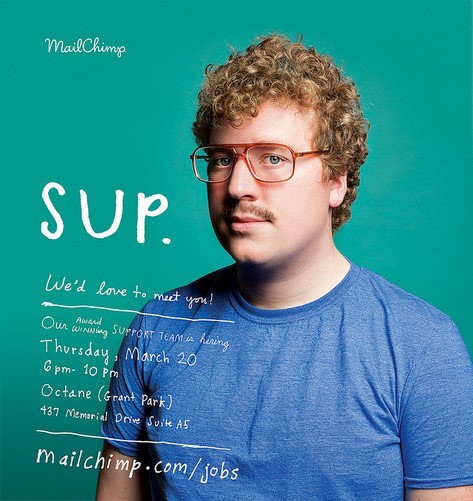
Rethinking your hiring process is a good start. But if your job ads and outreach still sound like they were written by the legal team, the best candidates will not bite. Mailchimp nailed it with their open day advert.
A job ad is not a list. It is a piece of marketing. Same goes for your careers page, follow-up emails and internal comms.
The strongest employers communicate clearly and confidently. They show what it is really like to work in the business. They connect with the people they want to attract and give them a reason to care.
Done properly, this alignment between brand, role and message turns job ads into quality conversations. And when internal comms back it up, you rely less on external hires altogether.
It Is Time to Stop Hiring on Autopilot
The businesses getting results are not pouring more money into ads or drowning in process. They are becoming more precise about where and how they find talent. They are using AI where it helps, stripping back where it doesn’t and sharpening every message they put out, including the job ad itself. That is how you attract the right candidates, not just more of them.
What the Best Job Ads Do Differently
- Clarity on what success looks like: Top candidates want to know what they are walking into. Spell out the impact they will have, the outcomes they will drive and how the role fits into the bigger picture. If it is vague, they will move on.
- A tone that reflects your real culture: Sound like yourself. If your team is fast-paced and commercial, show it. If you are measured and collaborative, say that. For the love of God, ditch the hyperbole (superstars, go-getters, we’re looking at you)! People read tone, and the wrong one turns strong candidates away.
- Clear signals on what matters most: Be direct about priorities. Are you hiring for mindset over experience? Looking for strategic thinkers or hands-on problem solvers? Candidates do not want to guess. Help them self-select in or out.
- Accessible, inclusive language: Lose the jargon and the legalese. If you say you value diversity, make sure your criteria and language reflect it. Keep it human, clear and realistic.
- A strong close with next steps: End with clarity. What happens after they apply? What should they expect? If you want to build trust, show it early.
If recruitment is broken, do not just add more noise. Fix what is not working and focus on what does. At Connected Content, we help businesses rethink recruitment comms so they attract the right people, not more noise. No jargon, no padding. Just results that make sense.
AI is not your replacement, it’s a shortcut!